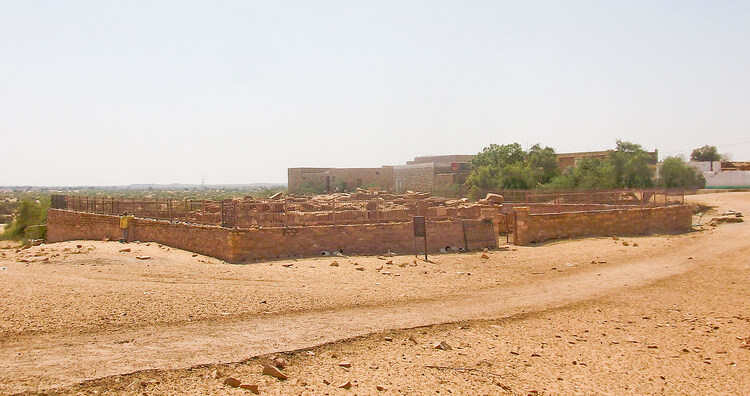
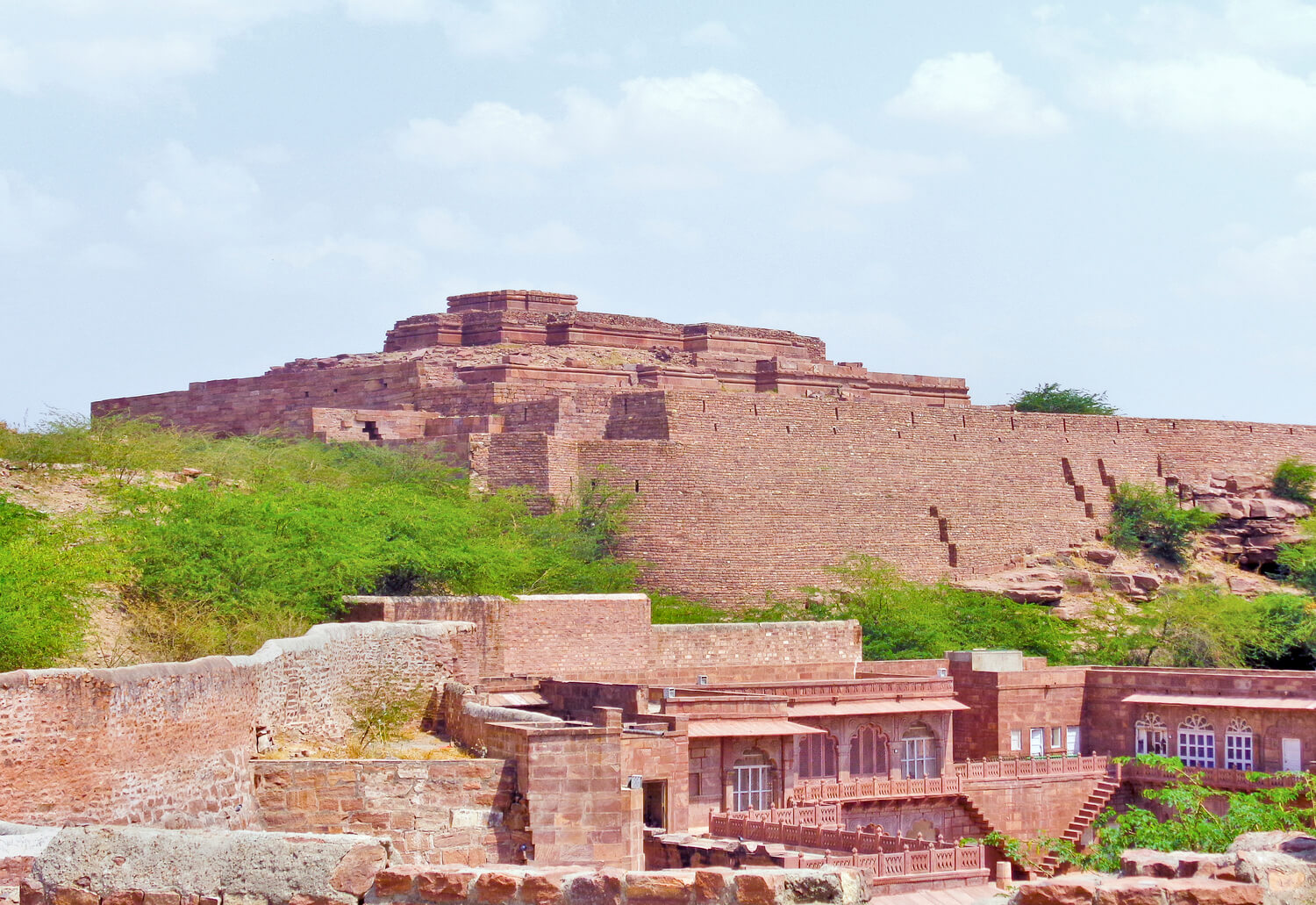
Jaisalmer Fort - UNESCO World Heritage Site
General View
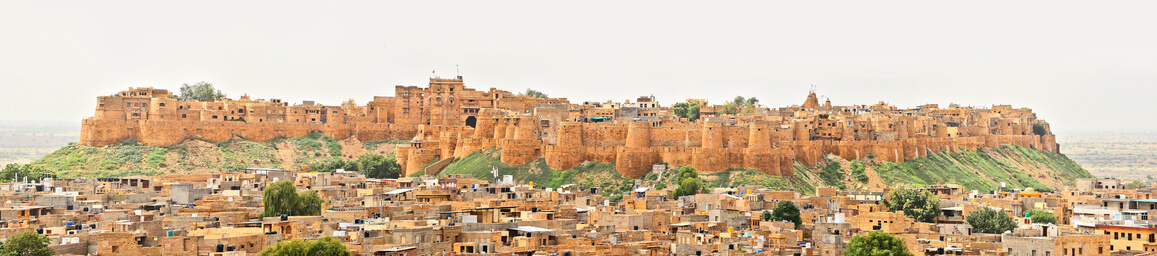
Jaisalmer, the capital of Bhati rulers is situated in 153 km from Barmer station. Legend has it that after battle of Kurukshetra, Krishna wandered around the desert of Thar with Arjuna, when he prophesized that one day, his descendant would build a desert fort around the Trikuta hill. Centuries later, a mendicant, narrated this celestial event and its significance to Rawal Jaisal, a Bhati ruler, who claimed to be a descendant of the Lunar race of the Yaduvansha dynasty.
Built in 1155 CE by Maharawal Jaisal on the Trikuta Hill. The fort occupies 11.28 hectares with ramparts 10-25 meters high.
He was ruling then from Lodruva, which lies along the dry bed of river Kak, was earlier called Lodruvapur and which he captured from the Lodruva Rajputs. He was looking for a chance to shift his capital due to the growing menace of Afghan raids and other tribes, posing grave dangers to the safety of his clan. The Trikuta hill on which the fort stands in the desert, proved to be strategic for its location and the natural defence of building a fort on a hill. After conspiring and killing his brother Bhoj Dev, he shifted his capital to Jaisalmer.
Evidence referring to the history of the region of Jaisalmer before Rawal Jaisal established his capital here, is scant. The name came into existence after Rawal Jaisal's construction of the Jaisalmer fort, derived from his name - Jaisal and meru - Jaisal's fort. Located at the southern end of a low range of hills, Jaisalmer sat strategically upon the camel caravan routes leading from India to Central Asia, Persia, Egypt, Arabia and Africa.
Jaisalmer evolved into a major trading outpost for trade in dates, wine, spices and dried fruits in exchange for textiles, gems, indigo, opium coming from west and central India. Being a capital, it also attained importance as the seat of administration for the Bhatti territories.
Rawal Garshi undertook the excavation of a large reservoir somewhere around 1346 CE. An old reservoir, Jaisalsar, built by Rawal Jaisal was enlarged and the waters of the nearby rivulet Kak were led into the Ranisar tank. The excess spilt over into the new reservoir, the Garhisar or the Gadisar.
The 16th century saw the first allegiances of Jaisalmer with Mughals. By 1570 CE, Jaisalmer had to finally succumb to Emperor Akbar's diplomatic maneuvers and by 1578 CE, Rawal Bhim's chiefs and their armies were placed at Akbar's disposal.
The 17th century saw the growing Mughal influence in Jaisalmer. In 1660 CE, Sabal Singh struck Dodia copper coins in Jaisalmer and circulated them. Jaisalmer was at the height of its expansion as it comprised the whole of present Bhawalpur and certain districts of Marwar and Bikaner.
The 19th century saw great changes and transition in the Jaisalmer state administration, marked by the receding influence of the Mughals and the growing influence of the British. Rawal Mulraj, faced with growing attacks and insecurity, signed a treaty with the British Government on 12th December, 1818 CE.
Four successive gateways: Akhai Pol, Ganesh Pol, Suraj Pol, Hawa Pol. Five palaces: Rang Mahal, Sarvottam Vilas, Gaj Mahal, Zanana Mahal, Moti Mahal. Important temples include Laxminarayan, Parsvanatha, Chandraprabhu and more.
The Fort of Jaisalmer standing majestically on the Trikuta Hill is a living testimony to the pride of the Bhati Rulers. Maharawal Jaisal laid the foundation of a new fort at Jaisalmer in 1155 CE, which was most probably completed before 1244 CE by Rawal Salivahan II. Also known as Sonar Killa due to its golden color, it is built over a 50 meter high hill with huge ramparts varying from 10 to 25 meters in height. There are three parallel walls around it. The rulers of Jaisalmer were great patrons of sculptural art and architecture. Several beautiful Brahmanical and Jain temples, magnificent palaces, havelis and gateways were built which clearly reflects the skill and dexterity of the stone masons and artistic excellence of the Bhati rulers.